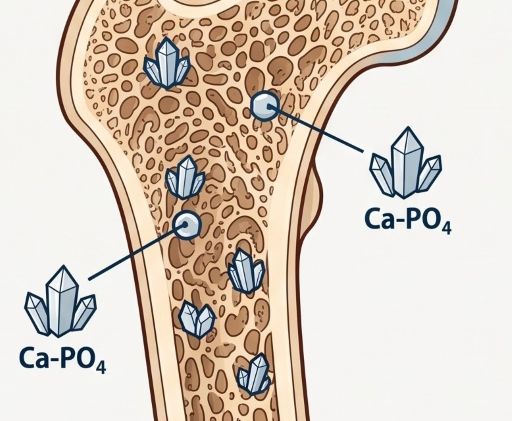

Someone suggesting, “My bones are weak, I need calcium,” seems simple enough, but the facts and science of this statement are actually quite complex.
For example, what exactly are the constituent parts of human bones? What is BMD and why is it important? How do you even begin to communicate to someone whether they need to up their amount of calcium or some other kind of mineral? When is the appropriate time to think about a bone density test?
Let’s simplify some things.
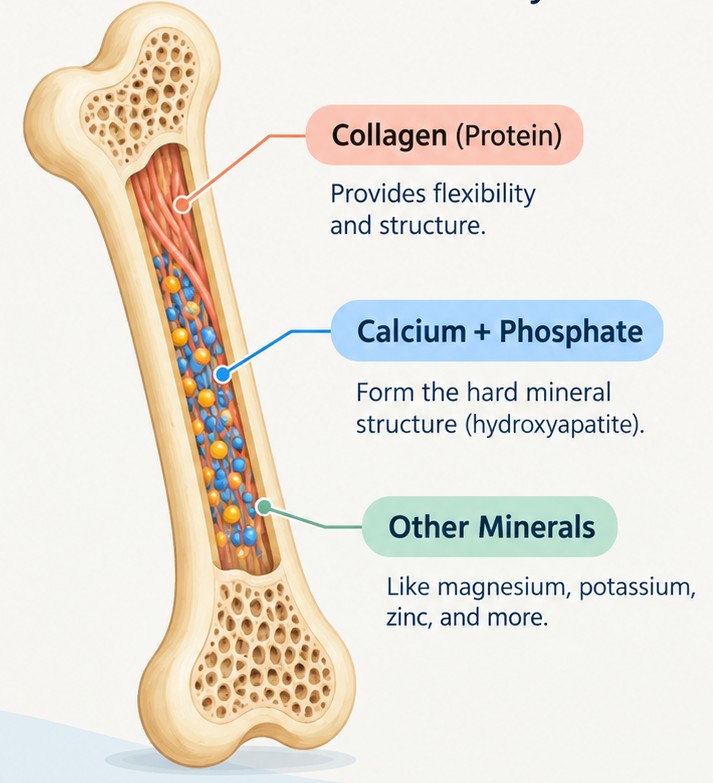
Calcium is important for bones, yes – but bones aren’t just made of calcium.
To understand the bone think of a strong building.
Collagen and other proteins form a flexible framework, and minerals are deposited into this framework, providing the hardness and strength to the bones.
The mineral component is primarily calcium and phosphate in a mineral structure known as hydroxyapatite. The body stores about 99 percent of its calcium in the skeleton.
So when we say “bone minerals” calcium is a big part, but not the whole story.
Calcium is needed not only for bones but also for important functions like muscle contraction, nerve function.
Your body maintains blood calcium levels within a narrow range. When calcium intake is low, the body can compensate for calcium balance by taking calcium from bone.
So just because your blood calcium level is normal doesn’t mean you have lots of calcium in your bones.
That’s one reason why a simple blood calcium test can’t tell you if your bones are strong or if you have osteoporosis.
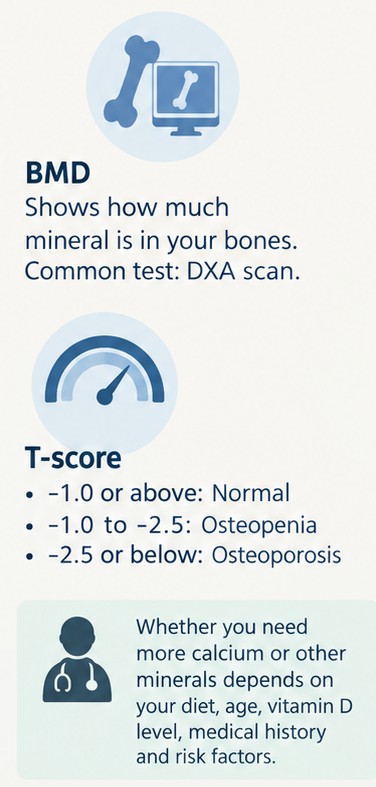
BMD (Bone Mineral Density)
Simply put, it tells you the mineral content of a certain area of bone.
The most common test is a DXA or DEXA scan. It is mainly used to measure the hip and spine and helps doctors determine the density of the bones and the risk of fracture.
Imagine BMD as testing the strength of a wall.
A denser wall is usually stronger, but wall density alone doesn't tell you everything about the condition of the wall.
BMD is also important but bone strength is also a function of factors other than mineral density.
A DXA report might give you a T-score.
For postmenopausal women and men aged 50 or older, commonly used categories are:
-1.0 or higher: normal bone density
Bone mass is low in the range from -1.0 to -2.5, a condition generally known as osteopenia.
-2.5 or lower: osteoporosis according to BMD criteria
Doctors do not consider the figure on its own. Previous fractures, age, medical conditions, medications, and the general fracture risk can also be relevant.
How will you know if your bones require calcium?
Herein lies the confusion for most people.
It does not involve the simple decision of taking calcium just because one suffers from back pain, joint pain or fatigue.
The following can be considered by a doctor:
1. Diet
Do you always eat adequate amounts of food that are sources of calcium?
2. Age and lifecycle of the person
lifecycle of the person
The requirement for calcium varies with age and certain lifecycle periods.
3. Vitamin D status
Since vitamin D plays a role in the absorption of calcium, low levels can mean that simply increasing calcium will not solve the problem.
4. Medical background
Certain medical conditions, drugs and hormone levels as well as digestion issues can influence bone health.
5. History of fracture and fracture risk factors
Fracturing a bone from relatively small trauma or fall may be an important indicator.
6. BMD/DXA scans when needed
When it is recommended for age and other reasons, a doctor will order a DXA scan.
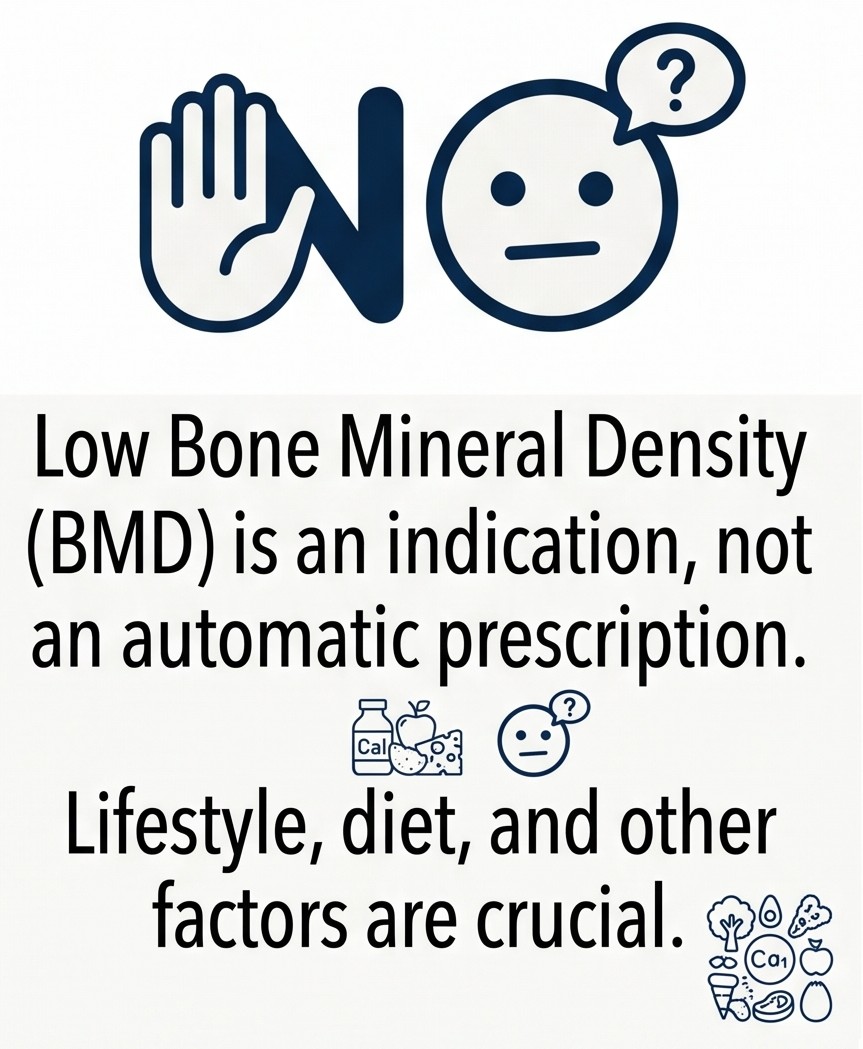
Not always.
It is advisable at first to ensure that you get enough calcium from your food.
The use of calcium supplements can be advised if you do not get enough from your food intake or for other medical reasons.
Having more calcium does not mean having a good thing.
Total intake of calcium involves both food and supplement intake.
What really builds healthy bones?
Healthy bones are developed from a variety of elements—not just a single element.
Healthy eating habits, good amounts of calcium and vitamin D, physical exercise, quitting smoking, reducing alcohol intake, and proper management of certain health problems could lead to the development of strong bones.
The simple takeaway
Bones are not just calcium.
Bones are more than just calcium.
Bones are living tissue built out of protein and minerals, with calcium and phosphates as primary structural components.
And BMD is a test that does not just tell you “you have enough calcium” or “you do not.”
It is one of the tools used to assess the condition of your bones and risk of fractures.
Thus, before taking any action to increase calcium supply in case you feel your bones are deficient,
ask yourself this question instead:
"Do I really lack sufficient calcium intake or bone health risk factors?"
SEO Title:
Are Bones Made of Calcium? BMD, Minerals & Bone Health Explained
Meta Description:
Are human bones made of calcium? Learn how calcium, phosphate, collagen and other minerals build bones, what BMD and T-scores mean, and when bone health needs evaluation.
Primary Keyword:
are bones made of calcium
Secondary Keywords:
what are bones made of · bone mineral density · BMD test · DEXA scan · calcium for bones · bone minerals · calcium and bone health · T score bone density · osteopenia vs osteoporosis · weak bones causes · how to improve bone health · vitamin D and calcium · bone density test
Author: Vipul Bhatnagar
Website: CareUnfiltered.in
Category: Nutrition, Health & Wellness / General Health Awareness
Research basis: NIAMS, International Osteoporosis Foundation (IOF), and Bone Health & Osteoporosis Foundation (BHOF). The key medical points above are consistent with their current patient/clinical guidance.